CHS://LAB — GAME UPDATES

What's new in the Lab

Every change to Charleston AI: The Lab, newest first. It is a free browser game about taking the empty office at Charleston AI and building an AI business out of it. No download, no account, no wallet.

  1. IMPROVED

    The Lab has a front door

    The first screen used to be words on black. Now it opens on the Charleston AI storefront, the same brick building with the white awning, above the same three lines that set the game up. Take the office and the building gives way to the empty office itself, drawn the way the game draws it, while you name your company.
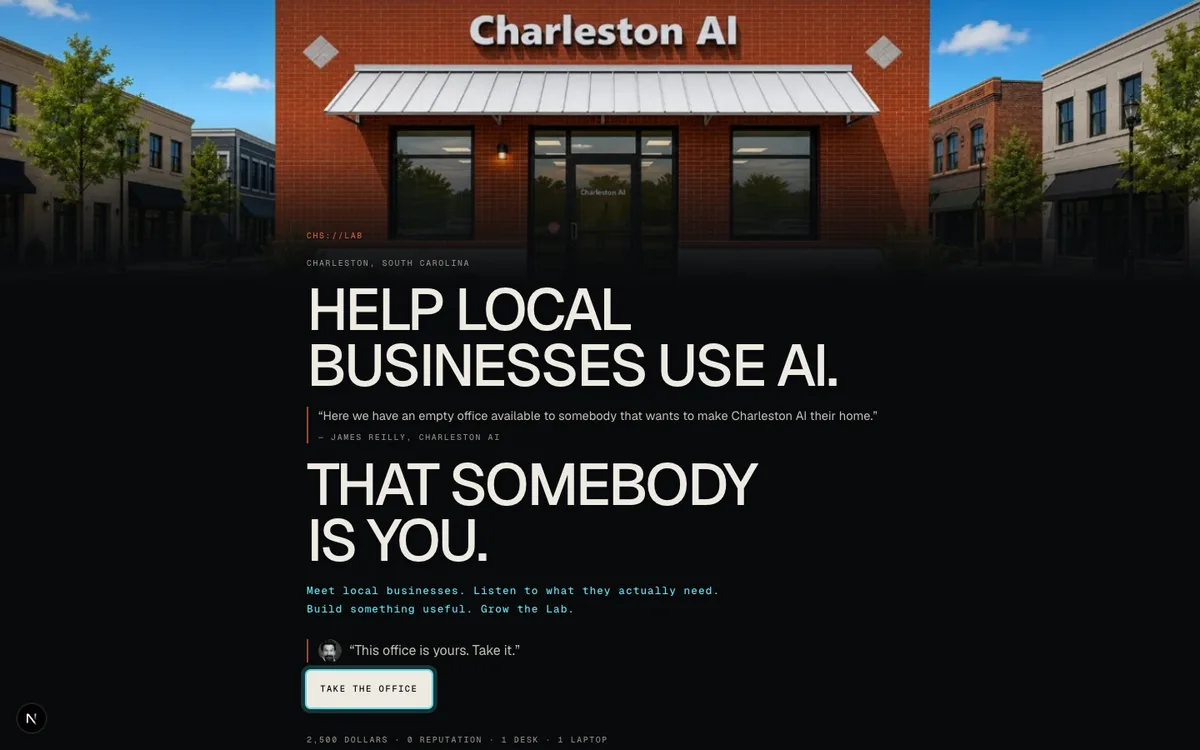
    The Lab's first screen: the red-brick Charleston AI storefront with its white awning across the top, and below it the lines Charleston, South Carolina, Help local businesses use AI, the quote about an empty office, That somebody is you, and the Take the office button.
    The front door, then the office. The lines are the ones you know.
    • The storefront sits above the opening lines and drifts slowly toward the door while you read
    • Take the office, and the picture opens into the empty office behind the company-name step
    • On a phone the picture is cropped to the door, so the sign and the entrance are what you see
    • Nothing about starting changed: the same three lines, the same button, the same first minute

    Worth knowing
    Only a new player sees the first screen; a returning player still lands straight in the office. The pictures are two small images that load once and never again.
  2. IMPROVED

    Pick your logo on the first screen

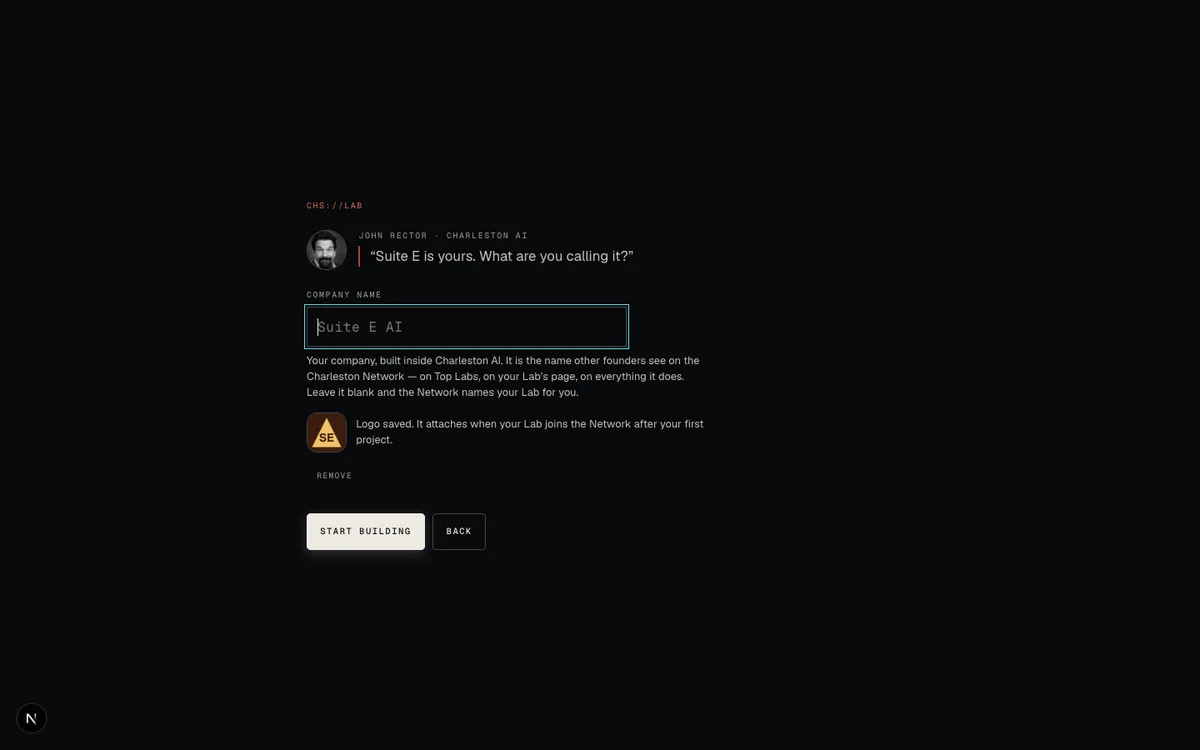
    You can give your company its logo at the very start now, on the screen where you name it. Sign in there, choose a picture, and it waits with your account. The moment your Lab joins the Charleston Network after your first project, one tap on the arrival notice secures the Lab and puts the logo beside your name.

    The naming screen: John Rector of Charleston AI asks Suite E is yours. What are you calling it? above an empty Company name field; under the note, a small triangle logo with the letters SE beside the words Logo saved. It attaches when your Lab joins the Network after your first project, a Remove button, and the Start building and Back buttons below.
    Saved before the first project, attached the moment the Lab joins.
    • Under the company name: Add a company logo? Optional. Sign in and add one
    • Sign in, choose a picture, save it; Start building works exactly as before whether you do or not
    • When your Lab joins, the notice reads: tap to secure your Lab and attach your logo
    • Changed your mind? Remove it on the same screen before you start, or in My Lab later

    Worth knowing
    The logo waits on your account for 30 days. A Lab that never finishes a project never joins the Network, so nothing is shown anywhere. The same rules as any logo apply: square, at least 128 pixels, yours to use and safe for everyone.

  3. NEW

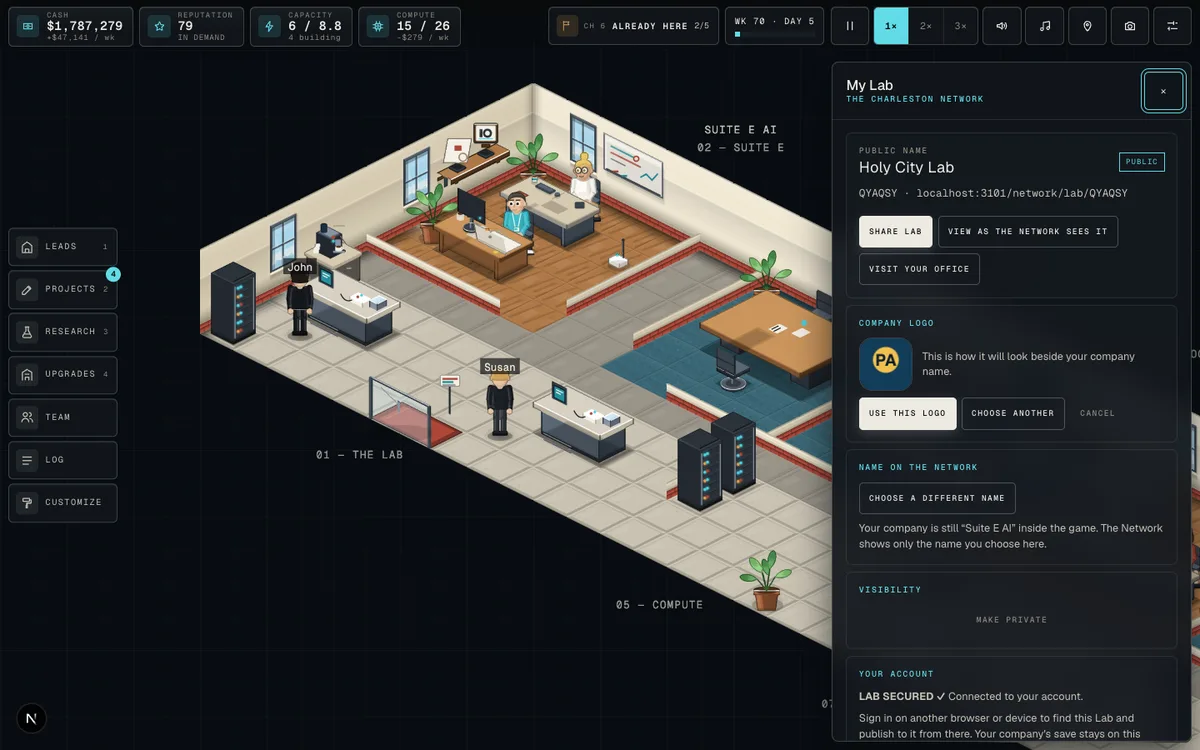
    Your company can carry a logo on the Charleston Network now. Pick a picture in My Lab, see it beside your company name before you commit, and it shows wherever the Network shows your name: the Activity feed, Top Labs, Discover, your Lab's page and the Visit bar. Until you add one, the Network keeps drawing the two-letter mark it always has.

    The My Lab panel open beside the office: under Company logo, a round yellow mark with the letters PA on a navy square sits next to the words This is how it will look beside your company name, with the buttons Use this logo, Choose another and Cancel; below it, Name on the Network, Visibility and Your account, which reads Lab secured.
    The preview in My Lab. Use this logo, and the Network shows it within a minute.
    • Settings, then My Lab on the Charleston Network, then Company logo: Add a logo, check the preview, Use this logo
    • Any PNG, JPEG or WebP at least 128 pixels on a side; your browser crops it square and shrinks it to 256, and only that small picture is ever sent
    • Replace it or remove it whenever you like; removing deletes it
    • A logo needs a secured Lab, so the first tap is Secure your Lab if you have not done that yet
    • Reports work the way they do for names: three Labs reporting a logo hide it until it is reviewed

    Worth knowing
    One logo change every ten minutes. It must be yours to use and safe for everyone. A hidden logo can be taken down but not replaced until it is restored, and a PRIVATE Lab shows nothing at all.

  4. WORLD

    The office, drawn in full on a desktop

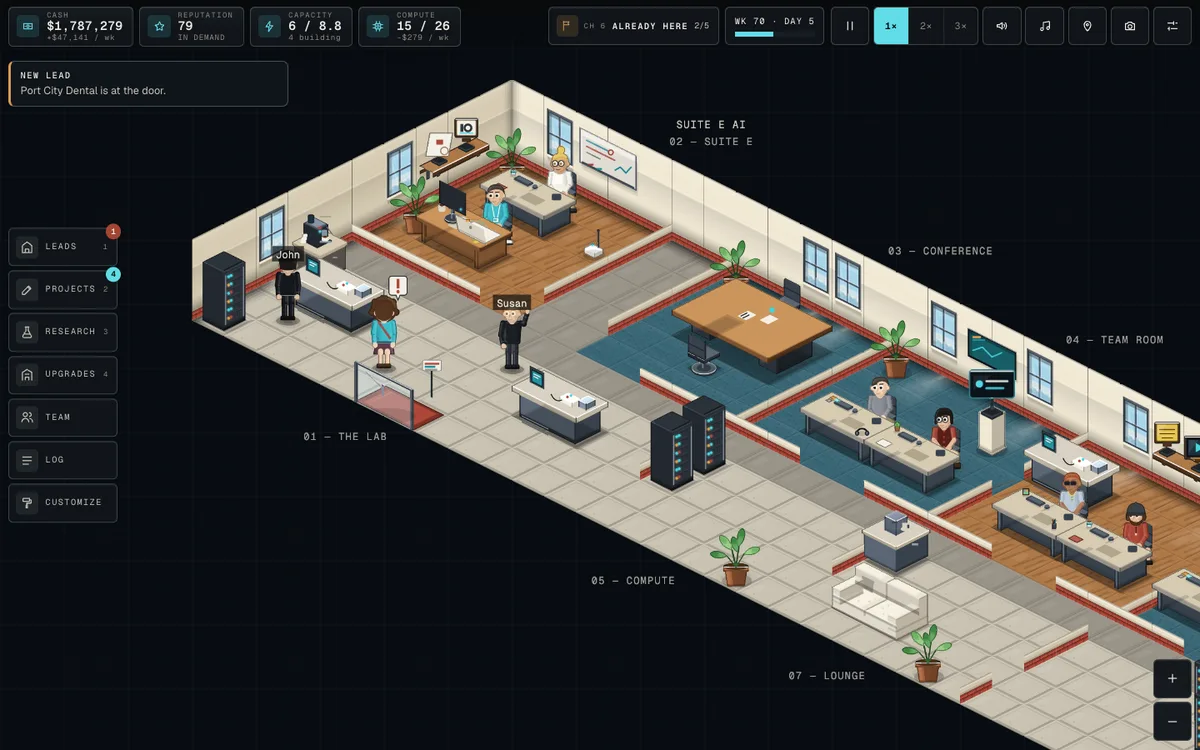
    Open the Lab in a desktop browser and every room, desk, chair, server, plant, person and trophy is drawn with more care than before: grain and sheen on the materials, light falling from the windows across the floor, a shadow where each thing meets the ground, a lit edge along every wall. It is the same office, the same layout and the same save. A phone keeps the lighter drawing it had, which is the right one for a small screen.

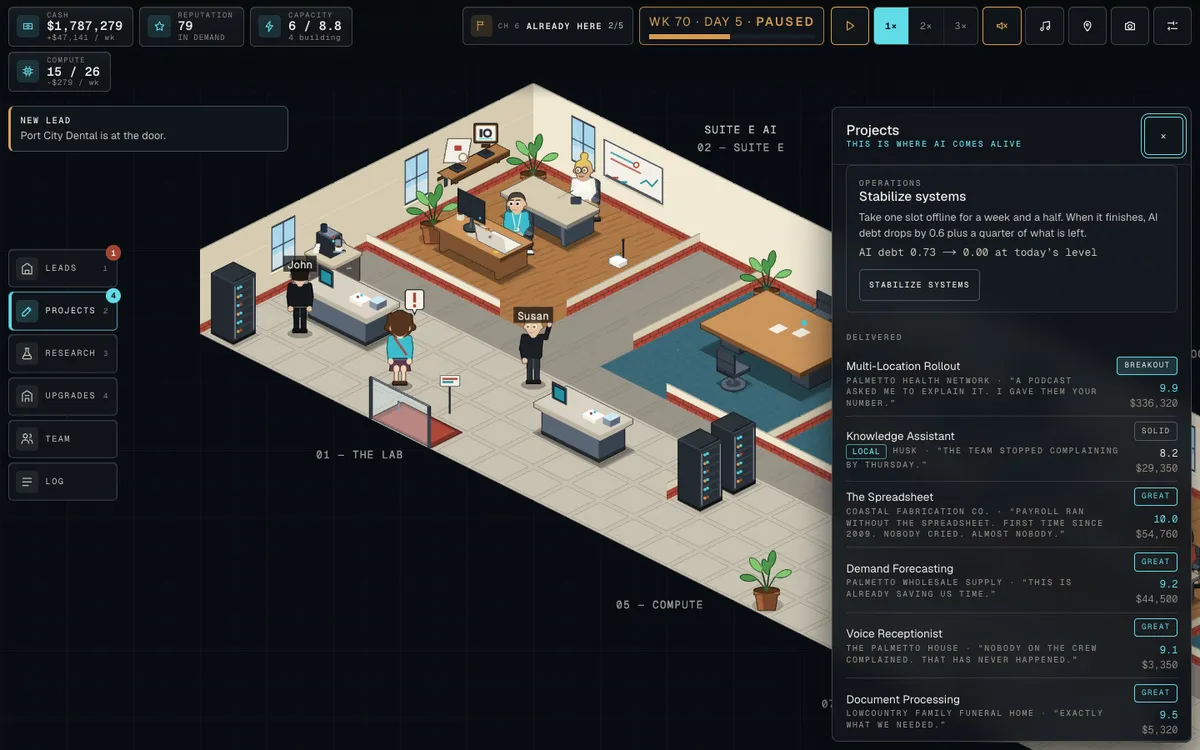
    The Lab on a desktop, HQ in week 70: cash, reputation, capacity and compute across the top, the panel rail down the left, a New lead notice saying Port City Dental is at the door, and the office itself drawn in full: Suite E with the founder at a wooden desk, John at the front desk beside a server rack, a visitor waiting by the door, Susan in the Lab, the conference table on blue carpet, the team room with people at their desks, and the lounge sofa, with light pools on the floor and a shadow under every piece of furniture.
    HQ on a desktop, mid-game. Same office, same save; a phone keeps the lighter drawing.
    • Every room style and material, from plank floors to Charleston stone to the night walls, has a richer desktop drawing
    • Each employee's desk now carries its own belongings: a mug, a notebook, headphones, sticky notes, a plant, a photo, a cup of pens
    • The light on the floor follows the room: an executive office glows warm, a server room cold, a night room barely at all
    • Visiting another Lab on a desktop shows its office the same way
    • Fixed on the way: upgrades no longer appeared at two-thirds size when a game opened paused, and the display stands stood a few pixels above the floor

    Worth knowing
    This is a change to how the office is drawn, not to how the Lab plays: the layout, the furniture, what everything costs and what a visitor can see are identical on a phone and a desktop. If the richer files fail to load, the office falls back to the standard drawing rather than to a blank room.

  5. IMPROVED

    Three questions, then make the call

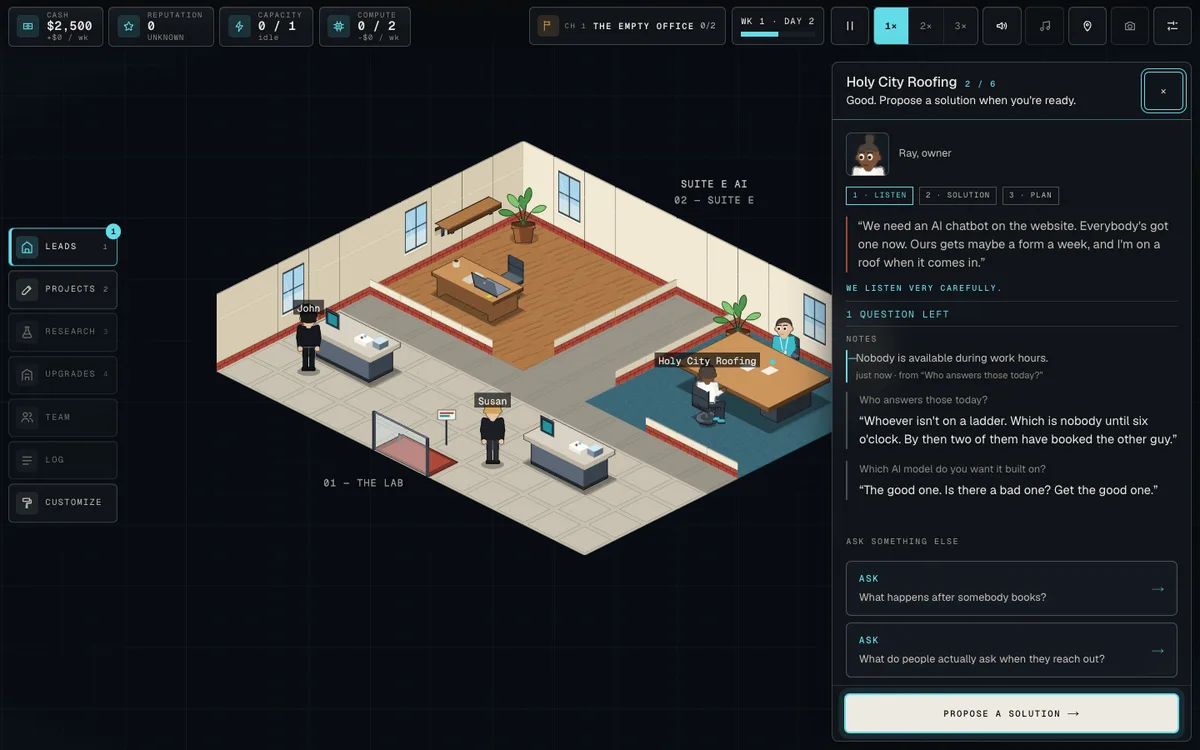
    With eight of the clients who come through the door, you now get three questions out of four before you have to recommend something. The one you skip stays skipped, so what you ask decides what you learn. The meeting reads as a transcript now, every note says which question earned it, and the options sit on the table as equal cards, including the honest one: you don't need this.

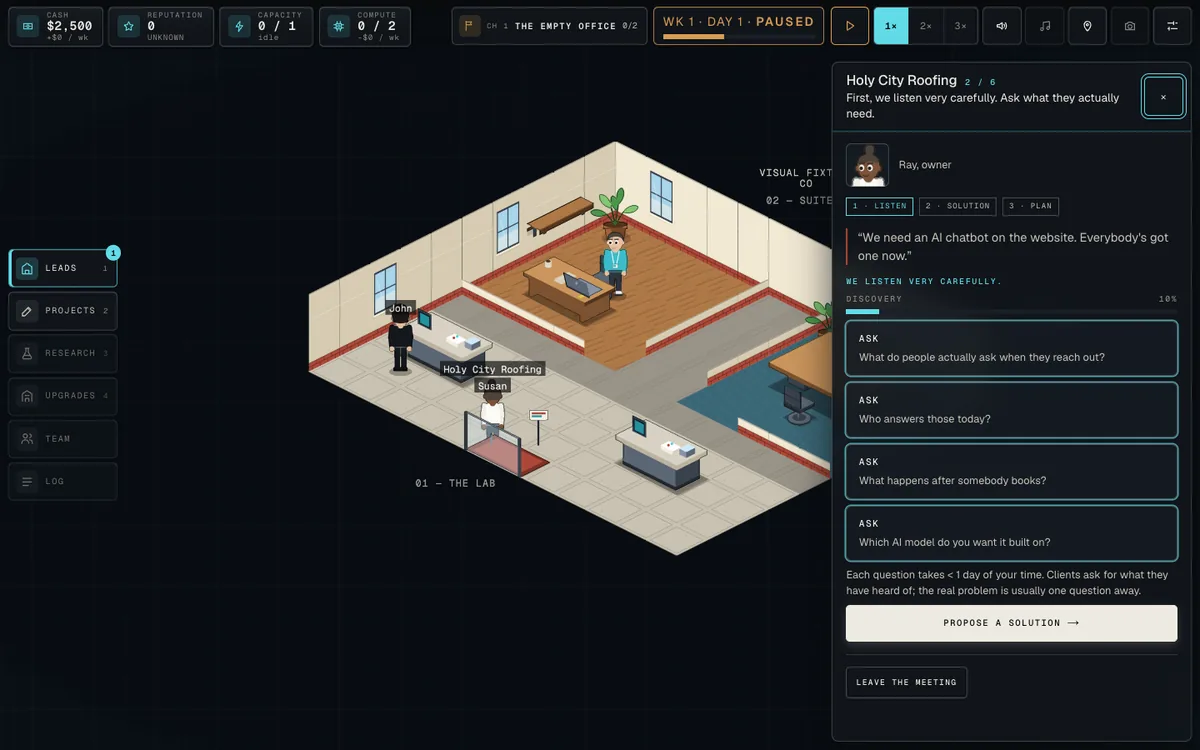
    The Holy City Roofing meeting on a desktop: Ray, owner, says they need an AI chatbot on the website; the sheet reads 1 question left, a note that nobody is available during work hours from the question Who answers those today?, two answered questions in full, two left to ask under Ask something else, and a Propose a solution button.
    One question left with Holy City Roofing. Whichever you skip, you skip.
    • Holy City Roofing, Bluffton Print & Sign, King Street Threads, Pineapple Fountain Tours, Sullivan & Vance, Vantage Loop, Coastal Fabrication Co. and Atlantic Coast Community Bank carry the three-question limit
    • "3 questions left" counts down from the first second; the question you can no longer afford stays on the sheet under Left unasked
    • Notes say where they came from, and the newest is marked just now
    • On the table shows everything the conversation surfaced with no ranking and no hint; what the client asked for looks exactly as legitimate as what you uncovered
    • Choose, then commit: a chosen card shows what we heard and what we'll recommend before the footer commits it
    • Answers read as a record and open questions read as buttons, and a New answer note appears when a reply lands below what you are reading
    • Two conversations were rewritten so that three questions can actually go wrong: Pineapple Fountain Tours and Bluffton Print & Sign

    Worth knowing
    Every other client keeps every question and the discovery meter. The transcript, the table and the commit step apply to every meeting, whoever is across from you. Your first project still cannot be lost this way.

  6. IMPROVED

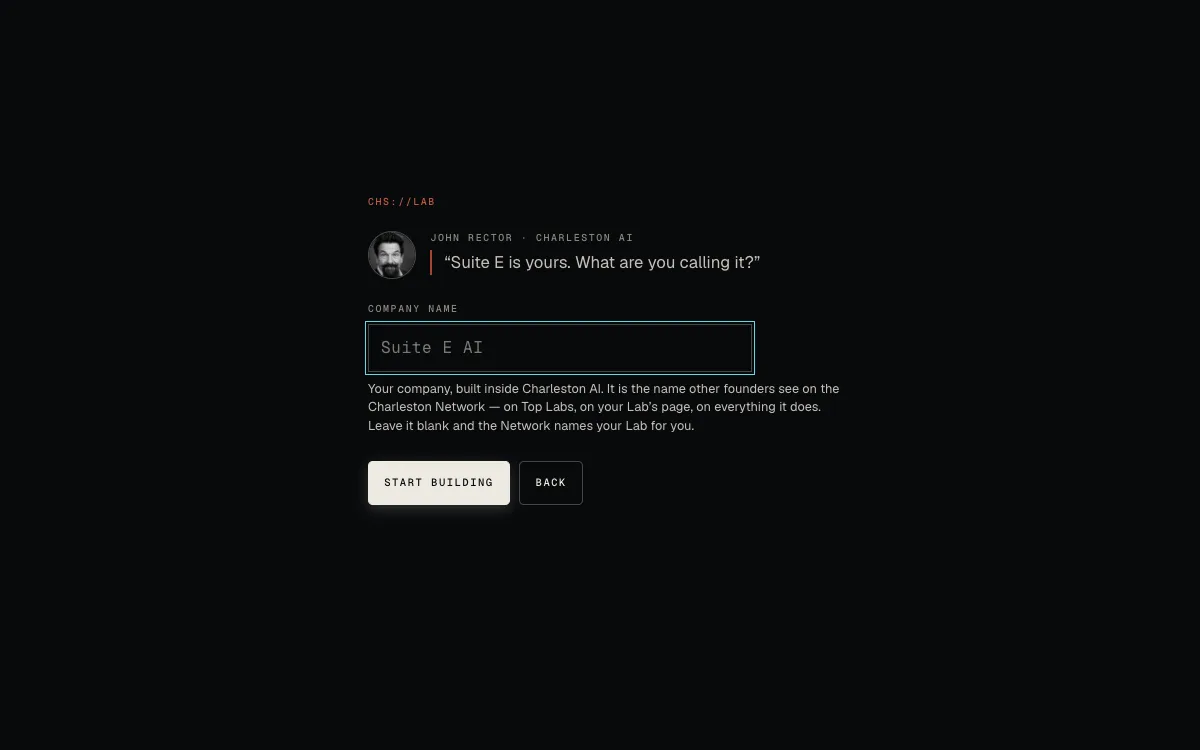
    Name your company, and the Network lists it that way

    The start screen now asks what you are calling your company instead of offering a name to delete. Whatever you type is the name other founders see on the Charleston Network: on Top Labs, on your Lab's page, on everything it does. Leave it blank and the Network names your Lab for you, and the moment it joins, one tap on the arrival notice lets you name it yourself.

    The start screen: John Rector of Charleston AI asks Suite E is yours. What are you calling it? above an empty Company name field showing Suite E AI as a placeholder, a note that it is the name other founders see on the Charleston Network, and a Start building button.
    What are you calling it? The name goes on the Network.
    • The field starts empty; Suite E AI is what the sign reads if you leave it, not an answer you have to delete
    • A Lab still carrying a Network-given name is listed as the company its founder named, once, unless the founder had already picked a name on the Network
    • When your Lab joins, the notice reads Listed as … tap to name it yourself, and takes you to MY LAB
    • That moment is no longer buried under first-project news: a retainer signing is a quieter note, and two milestones at once become one

    Worth knowing
    You can still rename the company in the Office at any time. A name you chose on the Network yourself is never replaced.

  7. NEW

    Put what you earned on display, where you choose

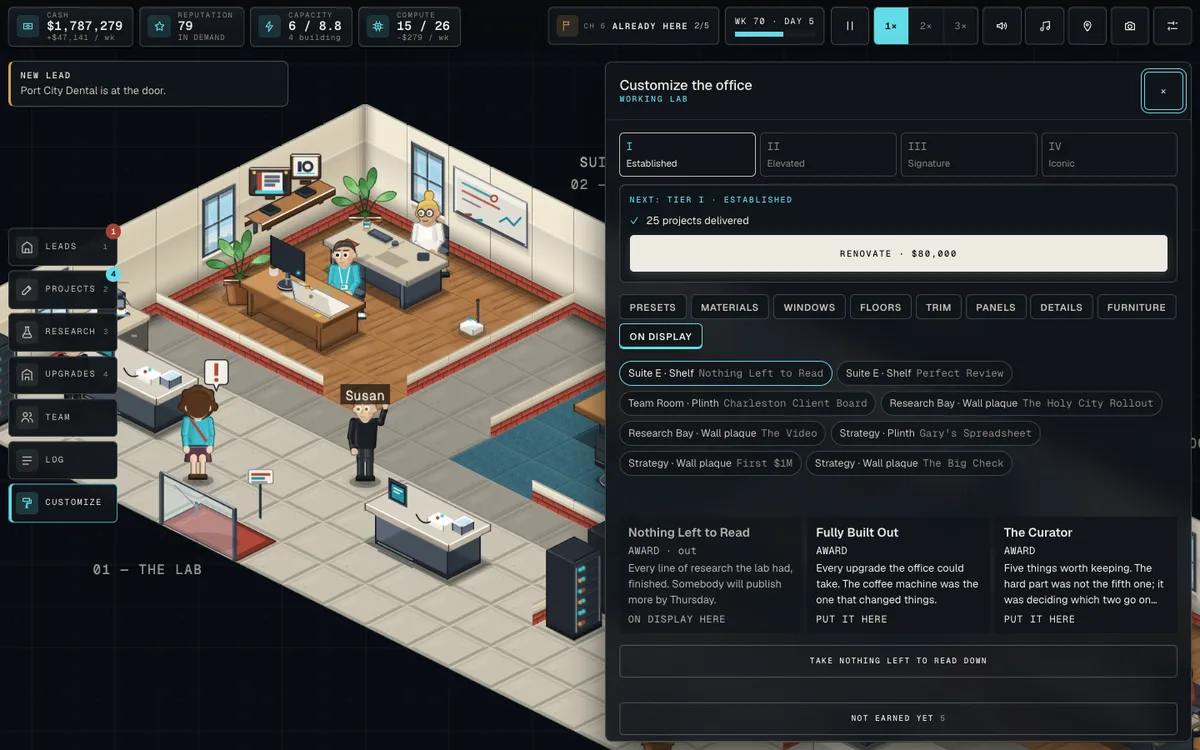
    Trophies used to land wherever the game put them. Now there is an On display tab in Customize the office: eight places at HQ, each one a real spot in a room, and every trophy goes exactly where you put it. Beside the trophies are eight awards the company earns by what it did rather than what it bought, and there are more things worth showing than places to show them.

    The Customize the office panel on its On display tab beside the office: eight places listed as Suite E shelf, Team Room plinth, Research Bay wall plaque and Strategy plinth and wall plaques, each naming what stands there; three award cards, Nothing Left to Read on display here, Fully Built Out and The Curator with Put it here; a Take Nothing Left to Read down button, and Not earned yet, 5.
    Nothing Left to Read on the Suite E shelf. Five awards still to earn.
    • Eight places at HQ: two shelves in Suite E, a plinth in the Team Room and in Strategy, wall plaques in the Research Bay and in Strategy
    • Put it here, Move here and Take it down are each one press, and all of it is free
    • Eight awards: Already Here, A Hundred Greats, Three Hundred Greats, Five Hundred After, Nine Figures, Nothing Left to Read, Fully Built Out and The Curator
    • Awards you have not earned sit under Not earned yet, so you know what is left to do
    • Visitors to your Lab see the shelves and the plaques exactly as you curated them
    • Changing what a case is made of never moves what is on it

    Worth knowing
    A smaller office has fewer places: the first office has the two shelves, and spots are added as the office grows to eight at HQ. Awards go on plaques and shelves; a trophy goes where its kind fits. Real Charleston businesses appear on trophies by name, as they always have.

  8. IMPROVED

    Visitors now see the office you built

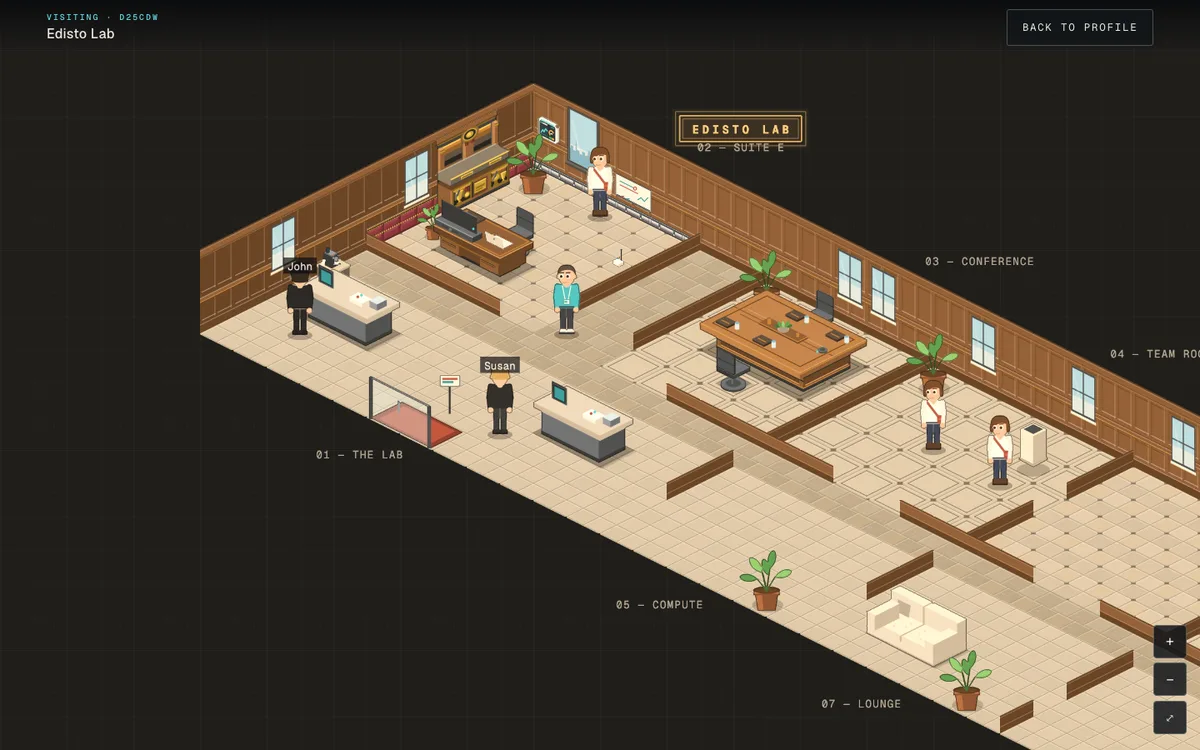
    Every customization update so far ended the same way: visitors still see the original office. Not any more. Dress a room and, within a minute, anyone who visits your Lab on the Charleston Network sees it the way you built it: the walls, the floors, the lighting, your desk, the meeting table, the server wall, the trophy case, and every wall, window and panel you changed one at a time.

    A visit to Edisto Lab on the Charleston Network: the whole office wearing walnut panelling, a lit brass sign reading Edisto Lab, a trophy case in Suite E, the conference table, people at their desks, and a Back to profile button.
    Edisto Lab, wearing Signature, as a visitor sees it.
    • Published about a minute after your last change, so a run of edits goes out as one
    • Buying a look publishes nothing; only wearing it does
    • A visitor never learns what you own but are not wearing, what anything cost, or what you have spent
    • An office still wearing the original look shows exactly as it did

    Worth knowing
    Your Lab has to be public for anyone to visit; PRIVATE in MY LAB keeps the office to yourself. A visit is a look, not a game: nothing a visitor does touches your Lab.

  9. NEW

    The last two renovations are open

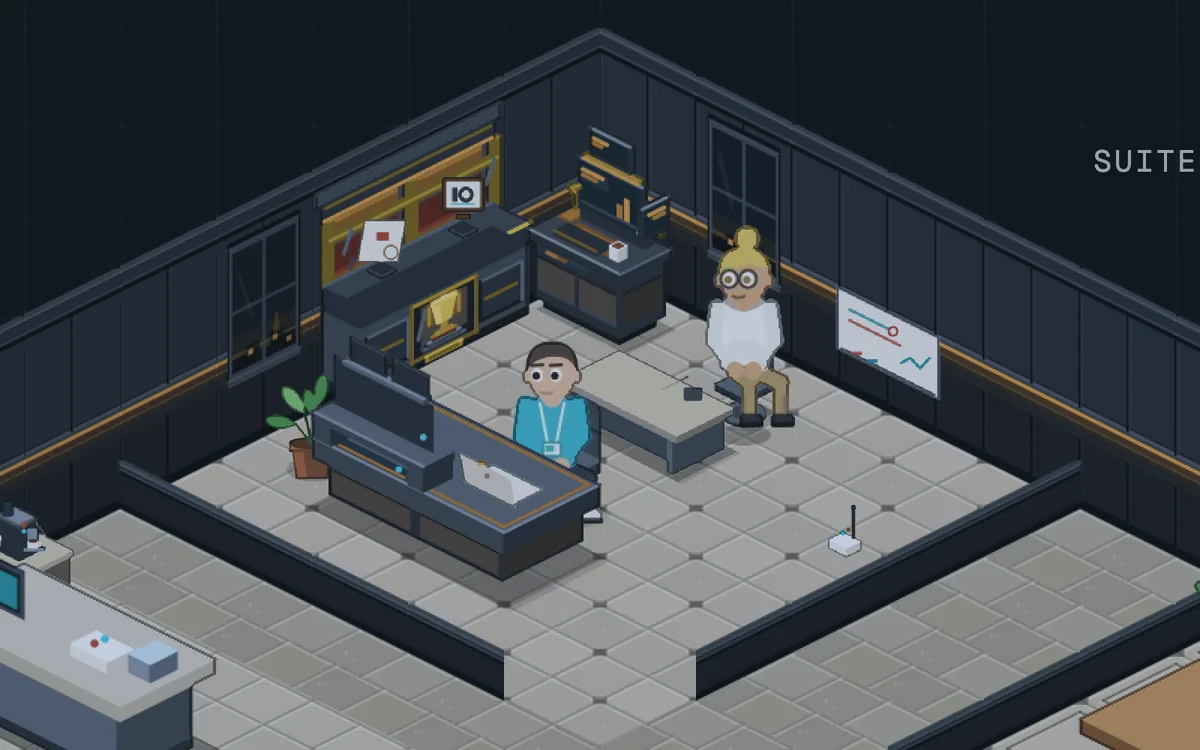
    Signature and Iconic were in the catalogue and out of reach. They are for sale now. Signature is what a company looks like once it has made it — walnut panelling, Charleston stone, an executive desk, a wall of racks. Iconic is the end of the road: night walls, a command station, a wall for what you have won, and a case for the thing that was never for sale.

    Suite E wearing the Iconic set: dark panelled walls with a warm light line running along them, a black command desk with a stepped screen wall, a lit collector's case holding a gold cup, an operator station with its own screens, and warm stone underfoot, with two people working.
    The Iconic set in Suite E. Everything in it can be swapped for anything else.
    • Signature opens after you finish the campaign, with six retainers, your debt in hand and a reputation to match
    • Iconic asks for a great deal more: 500 projects since the campaign, 300 of them great, and five collectibles
    • Two pieces are earned as well as bought — the trophy wall wants collectibles, and the collector's case wants a legendary outcome
    • Every prestige piece still mixes with everything below it: a $9,750,000 wall over a $20,000 plank floor is a perfectly good office
    • Four room styles come with them — Premium Executive Office, Dark Server Room, Sci-Fi Command Room and Cyberpunk Workspace

    Worth knowing
    Looks change how the office looks, not how the Lab plays. These two renovations are meant to take a long time: Signature comes at the end of the campaign, and Iconic is a deep-Endless goal you are unlikely to finish buying. Visitors to your Lab saw the original office until September 12.

  10. NEW

    Every wall can have its own look

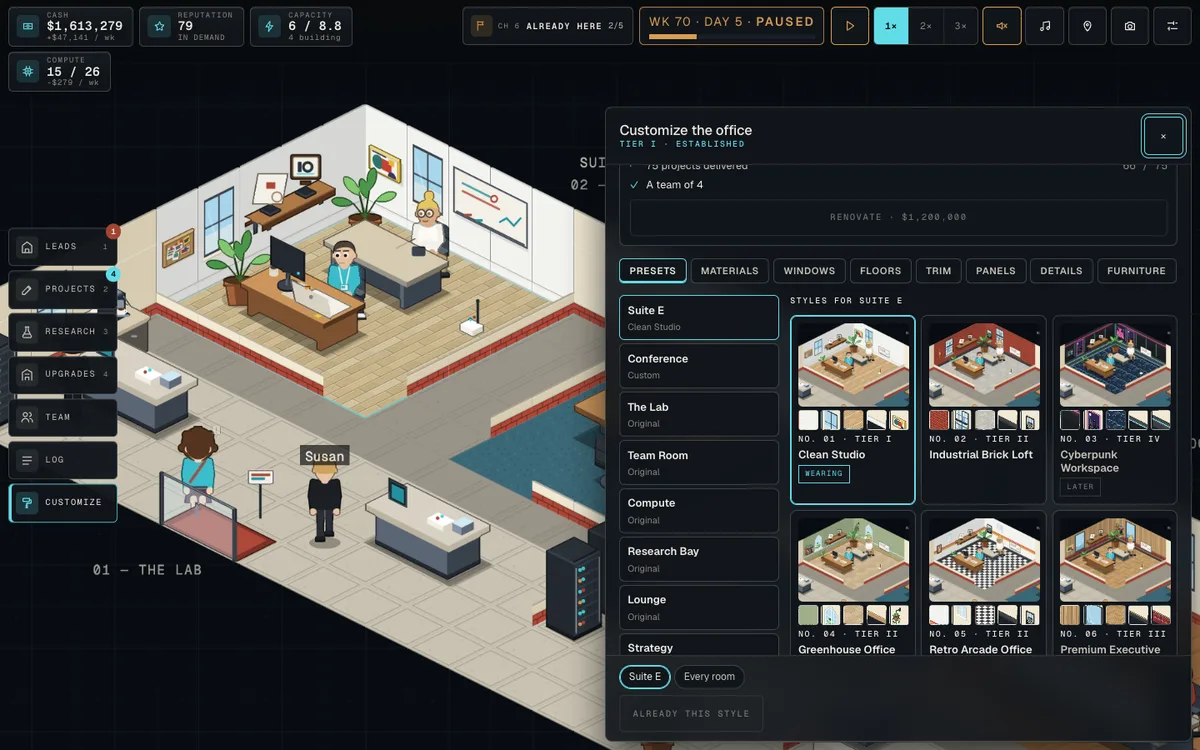
    Customizing the office used to mean one look for the whole place. Now you pick a room, then a single wall, window, floor, panel, trim line or spot on the wall, and change just that one. Buy a look once and it is yours to use anywhere in the office, as often as you like, for nothing.

    The Customize the office panel open beside Suite E. A list of rooms shows Suite E wearing Clean Studio, Conference custom and The Lab original; tabs read Presets, Materials, Windows, Floors, Trim, Panels, Details and Furniture; six room styles are shown with their swatches, Clean Studio marked Wearing and Cyberpunk Workspace marked Later.
    Twelve room styles, and every wall, window, floor and panel underneath them.
    • Six things to change in every room: walls, windows, floors, trim, lower-wall panels and wall details
    • A look is bought once, then free on every other wall, window or floor you put it on
    • Twelve room styles dress a whole room in one go, and you only pay for the pieces you don't already own
    • Change any part of a style afterwards — a brick wall next to a white one is a perfectly good office
    • Looks start at $5,000, and every one previews in the room before you spend anything

    Worth knowing
    Looks change how the office looks, not how the Lab plays. Which looks you can buy still depends on how far you have renovated, and the boldest ones — the neon, the marble, the arcade floors — are in the catalogue marked Later: you can look at them, but not buy them yet. Visitors to your Lab saw the original office until September 12.

  11. NEW

    Renovate the office and make it yours

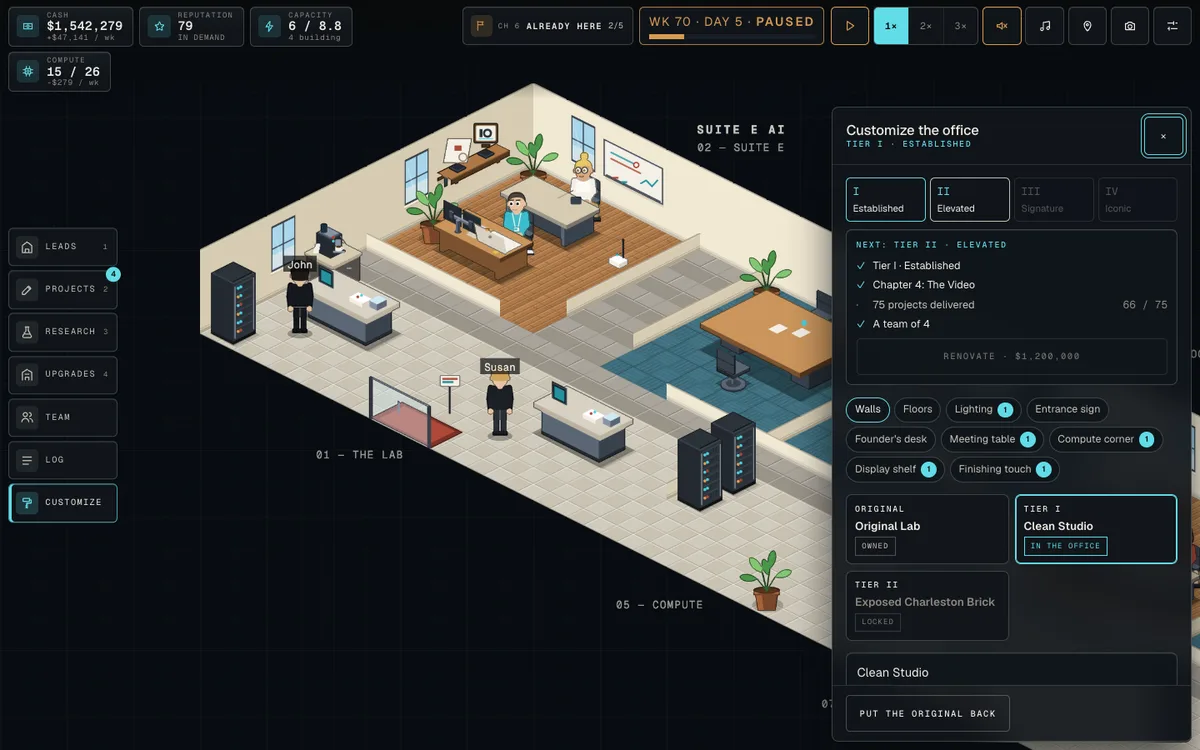
    Once your Lab has 25 projects behind it, you can renovate. A renovation opens new looks for nine parts of the office, from the walls, floors and lighting to your own desk and the sign by the door. Try a look in the room before you buy it, and put the original back whenever you like.

    The office wearing Clean Studio walls, Polished Boards floors, a dual-screen founder's desk and a heavier sign face, beside the Customize the office panel at Tier I, Established: Clean Studio is in the office, Exposed Charleston Brick is locked, and the next renovation, Elevated, needs 75 projects.
    Clean Studio walls, Polished Boards and a dual-screen desk. The original is one click away.
    • Customize is on the dock on a desktop, and under Upgrades on a phone
    • The first renovation, Established, costs $80,000 and opens nine looks from $25,000
    • Every look previews in the office first, and once bought it is yours to keep
    • Switching between looks you own, or back to the original, is free

    Worth knowing
    Looks change how the office looks, not how the Lab plays. The second renovation, Elevated ($1,200,000), needs Chapter 4, 75 projects and a team of four, counting you, and opens nine more looks and the After Hours set. Two further renovations come later. Visitors to your Lab saw the original office until September 12.

  12. NEW

    The Network now shows everything Labs do

    The Charleston Network's Activity feed became a hub. Deliveries and who they were for, clients signed, hires, research, upgrades and incidents appear as Labs play, grouped by Lab and coloured by kind.

    • Eight filters: Delivered, Clients, Team, Research, Office, Prizes, Incidents, Milestones
    • Page back through older activity instead of stopping at the newest twenty
    • New milestones: a Lab opening its doors, reputation bands and businesses helped
    • A Lab's profile shows its twelve latest updates in the same style

    Worth knowing
    Hires appear by role, never by name, and no money is ever shown. Real Charleston businesses only appear next to good or neutral news. Turn your Lab PRIVATE in MY LAB and none of it is published.

  13. IMPROVED

    Retainers are relationships now

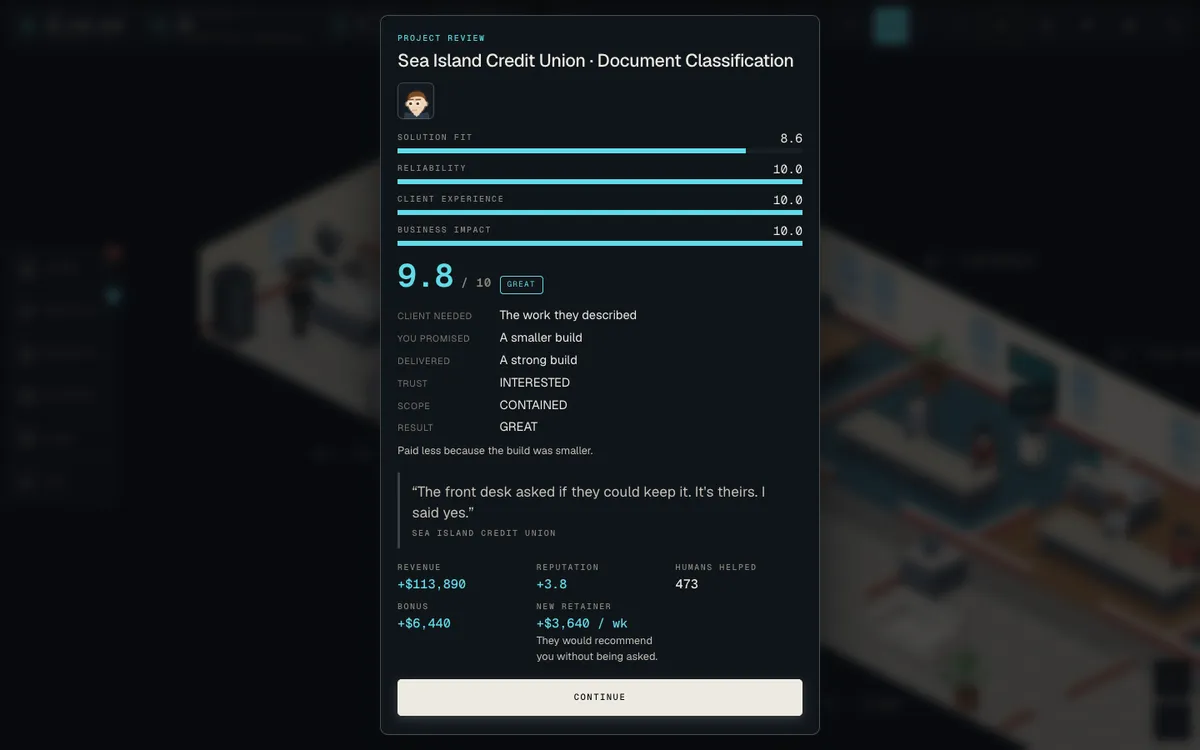
    When a project ends, whether the client stays on, and for how much, now depends on how they felt about it: the review they gave, how much they trusted you when the deal closed, and whether you delivered what you promised. Solid work can earn a retainer. A poor review can't.

    A project review for Sea Island Credit Union, 9.8 out of 10 and paid less for a smaller build, ending with a new retainer of $3,640 a week and the line: They would recommend you without being asked.
    A new retainer, and where you stand with the client.
    • Solid work earns a retainer, not only great work
    • The review tells you where you stand: another chance, steady work, or a client who would recommend you
    • A shaky relationship pays less for less time; a strong one pays more
    • A poor review strains the relationships you already have, and one can end

    Worth knowing
    Only for projects that finish after this update, and only for ordinary clients once you are past your first two projects. Retainers you already hold keep their old terms, and special clients, cameos and event visitors keep the old behaviour.

  14. NEW

    Stabilize systems to pay down AI debt

    AI debt used to come down only on its own, and slowly. Now you can deal with it: take one slot offline for a week and a half to clean up, and the debt drops when the work is done.

    The Projects panel with a Stabilize systems card that takes one slot offline for a week and a half, showing what it would do to today's AI debt.
    Take a slot offline, pay the debt down.
    • Find it in Projects, beside your AI debt, once debt reaches 0.4
    • It costs a slot, not cash: one fewer project while it runs
    • When it finishes, debt drops by 0.6 plus a quarter of what is left
    • One at a time, and it takes up capacity like a project while it runs

    Worth knowing
    It needs a free slot, so when every slot is working it waits for a project to finish. The debt comes down in one step at the end, not gradually.

  15. IMPROVED

    Two ways through the last two chapters

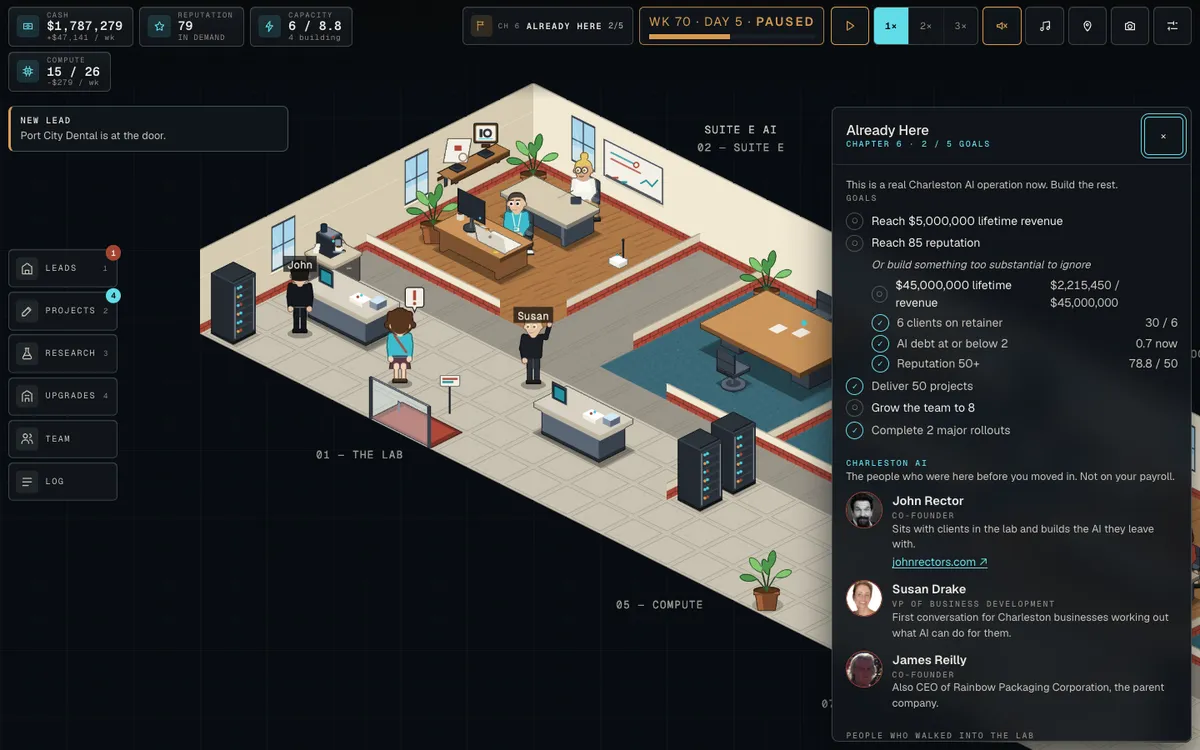
    Chapters 5 and 6 used to have one road: build your reputation to 75, then to 85. Now there is a second. Prove you are a company clients cannot do without, with the revenue, the retainers and the discipline to show for it, even if your reputation is only middling.

    The Chapter 6 campaign panel: reach 85 reputation, or $45,000,000 lifetime revenue with six clients on retainer, AI debt at or below 2 and reputation 50 or more.
    Chapter 6: build trust, or build something too substantial to ignore.
    • Chapter 5: reach 75 reputation, or $12 million lifetime revenue with six clients on retainer
    • Chapter 6: reach 85 reputation, or $45 million lifetime revenue with six on retainer
    • The second road also needs AI debt kept low (2.5, then 2) and reputation of 50 or more
    • Every other goal in those chapters still has to be met

    Worth knowing
    The second road opens for companies that have taken on work under the newer deal terms. A campaign played entirely before them keeps the single road.

  16. IMPROVED

    Reputation follows the work you ship

    Good news in the story used to pay the same reputation however little you were delivering, so a slow lab could collect more standing from events than from its own work. Now it scales with what you have shipped lately, and a poor review costs you instead of adding a little.

    • Story events pay reputation in proportion to your recent deliveries
    • Bad news is never scaled down
    • A poor review now lowers your reputation; solid work raises it
    • The events themselves are unchanged: same stories, same order

    Worth knowing
    Only for companies that have taken on work under the newer deal terms. A campaign played entirely before them keeps the old accounting.

  17. IMPROVED

    What you promise now changes the pay and the review

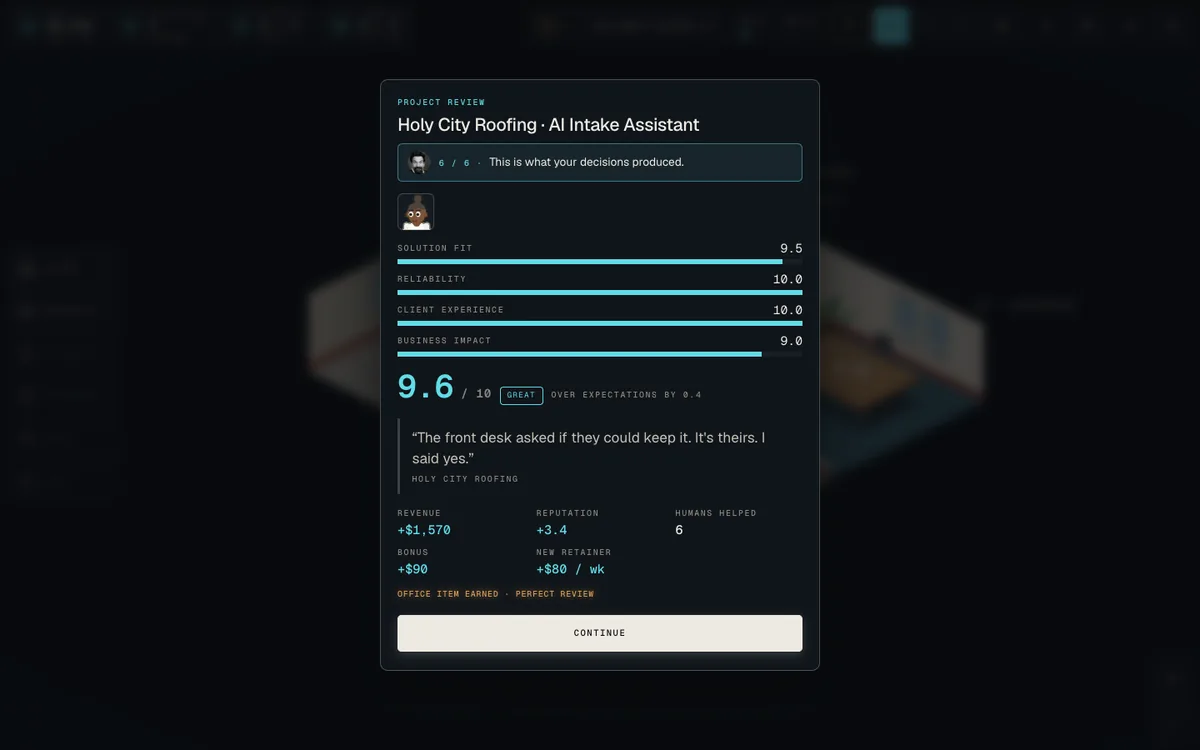
    The terms you close a deal on now follow the project all the way to delivery. A discount pays less, a bigger promise raises the bar the client judges you against, and overpromising starts the build already carrying extra scope and AI debt.

    A project review scoring solution fit, reliability, client experience and business impact, with revenue, reputation and a new retainer.
    The project review: what you promised, what you delivered, and what it paid.
    • Deals close as won, discounted, reduced scope, or with high expectations
    • A discounted deal pays less at completion; a high bar pays a premium
    • Overpromising adds scope pressure and starts the project in AI debt
    • The review shows what they needed, what you promised, what you delivered

    Worth knowing
    Only ordinary clients from leads that arrive after this update, and only once you are past your first two projects. Projects already in flight, special clients, cameos and event visitors keep the old behaviour.

  18. NEW

    Clients push back in meetings, and can walk away

    After you propose a solution, the client asks a question of their own. Your answer moves their trust against what they actually told you, and reading the room badly can lose the deal outright.

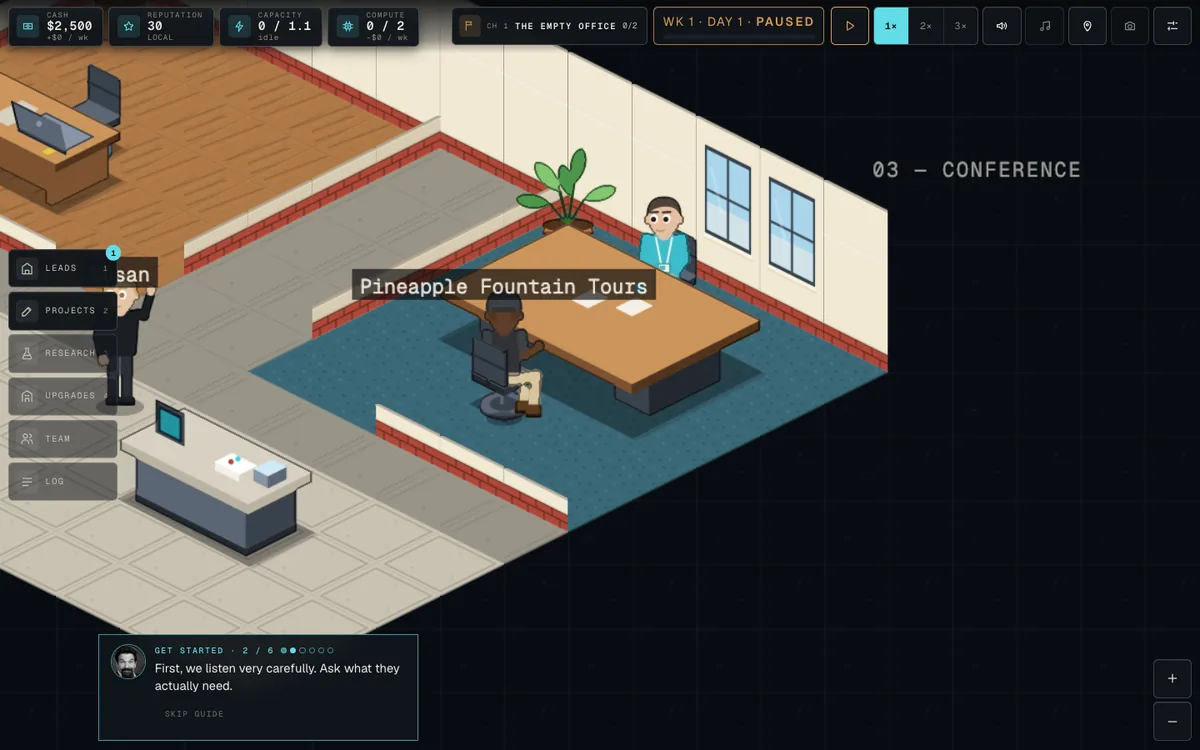
    The isometric conference room with the founder and a client from Pineapple Fountain Tours seated across the table.
    Room 03. First we listen very carefully.
    • A client question with three or four answers, after you choose the solution
    • Notes list only the facts you actually uncovered in discovery
    • Trust reads as a word: Skeptical, Cautious, Interested, Confident
    • A lost deal is real: no money, no project. Honestly disqualifying is separate

    Worth knowing
    Your first project can never be lost this way, and the second project's question is a low-stakes introduction with no walk-away risk. Leads already waiting at your door when the update landed keep the old meeting.

  19. NEW

    Browse the Charleston Network: activity and top Labs

    The Network gained pages worth browsing. There is a feed of what public Labs have been doing, leaderboards for this week and all time, and a Discover page for finding Labs to visit.

    • An Activity feed built from what public Labs actually published
    • Top Labs boards for this week (Monday to Monday, UTC) and all time
    • A Discover page that leads with the company name and keeps the Lab ID visible
    • Public profiles show their own recent activity and up to two rank chips

    Worth knowing
    The activity feed and the weekly board need a Lab's second publication before they have anything of their own, so right after a release they show real Labs borrowed from the other boards instead of inventing events.

  20. NEW

    Back up your Lab and continue it on a new device

    Once your Lab is signed in you can turn on an encrypted private backup. A different browser or device can then pick that Lab from Your Labs and continue exactly where you left off.

    • Cloud Backup lives in MY LAB, with a Back Up Now button
    • Backups run on their own after a local save; the game never waits on one
    • Your Labs offers Continue for any Lab that has a backup
    • If two devices diverge you get one sheet with two clear choices

    Worth knowing
    There is no backup history to browse and no way to restore an older revision on purpose. A corrupt newest backup falls back to the last healthy one automatically and tells you so. Cloud backup is a web feature; manual export and import stay for everything else.

  21. NEW

    Secure your Lab with an email sign-in

    You can attach your Lab to an account with an emailed code, so losing a browser does not mean losing your Lab's identity. Signing in elsewhere finds the Labs you secured.

    • Secure your Lab from MY LAB; sign-in is email only, no wallet
    • Your Labs in the site navigation lists the Labs on your account
    • "Already have a Lab? Sign in to find it on this device" under Take the office
    • Nothing from the sign-in library loads until you tap Secure your Lab

    Worth knowing
    Signing in secures your Lab's Network identity, not the save itself. Carrying your actual progress to another device needs Cloud Backup, which shipped the following day.

  22. NEW

    Publish your Lab and let people visit it

    Your company gets a public page on the Charleston Network once you finish your first project: a profile, a share card, and a read-only visit that renders your actual office.

    • MY LAB in Settings shows your Lab, its status and a one-tap PRIVATE switch
    • A visit renders the real office read-only: no clock, no saving, no changes
    • Every Lab gets a generated Charleston name; you can use your company name instead
    • The public page never carries your company name unless you choose it

    Worth knowing
    A Lab is public from the moment it is minted, which happens after your first completed project. What is published is a bounded snapshot, and PRIVATE removes the profile, the visit, the listings and the share card completely.

  23. NEW

    Hire a receptionist to screen who reaches you

    An Operations hire who caps how many ordinary inquiries wait at your door, so a busy late game stops burying you in walk-ins you will never get to.

    • Three policies: Open Door (no cap), Steady (4 waiting), Selective (2)
    • Hire from the Team panel; it costs a weekly salary and defaults to Steady
    • Rare, exceptional, legendary and special visitors are never screened
    • The Leads panel shows the policy, the queue and how many were screened

    Worth knowing
    The receptionist adds no delivery capacity, has no dedicated art or front desk in the office yet, and only affects future arrivals. A queue that is already waiting stays exactly as it is.

  24. WORLD

    The whole office redrawn in one authored style

    Every sprite now runs through a single premium illustrated style at build time. New couch, coffee station, server racks, shelves and display plinths, with real contact shadows instead of soft blurs.

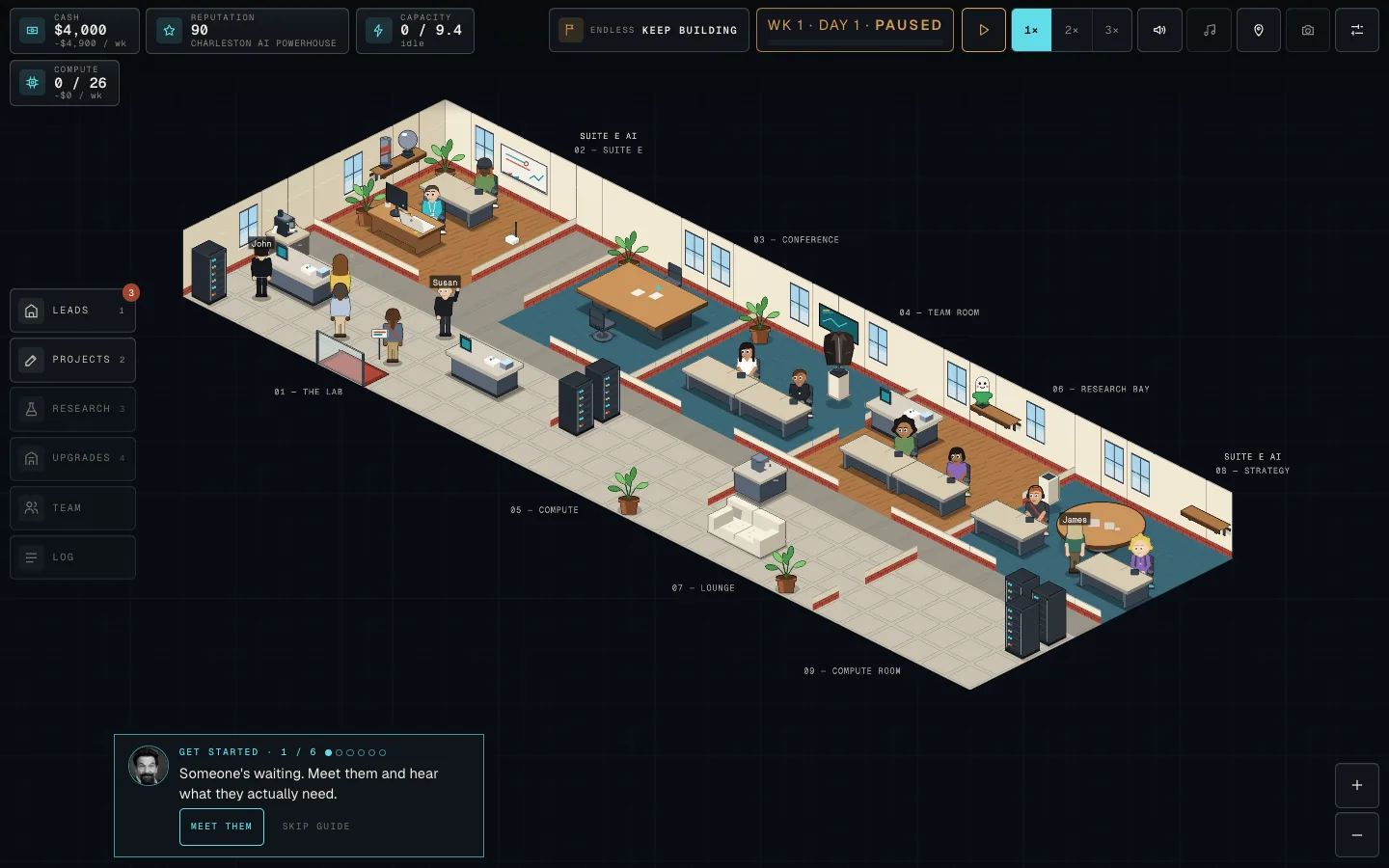
    A full Charleston AI office in isometric view: the lab, conference room, team room, research bay, lounge and compute room, with staff at their desks.
    A grown Lab, drawn in the authored style across every room.
    • One art direction across all six atlases, with no exceptions
    • Collectibles stand on a true isometric slab instead of a floating ellipse
    • Grounded shadows hug each footprint; no blurred sprite shadows remain
    • Alon has a bespoke look and portrait, alongside redrawn trophy art

    Worth knowing
    Three trophies still carry their old names (Golden Pump, Chrome Rocket, The GPU) even though the art changed. Renaming them is deliberately deferred.

  25. IMPROVED

    One thing at a time on screen, never a pile-up

    A single authority now decides what deserves your attention. Cards, ribbons and cast lines queue instead of stacking, so a cameo arrival, a milestone and an event card cannot land on top of each other.

    • At most one transient card, ribbon or toast on screen at any moment
    • Toasts no longer stack four deep; milestone bursts fold into one ribbon
    • Important cards wait for a quiet moment and never cover a meeting or sheet
    • The pause indicator moved into the clock instead of its own overlay
  26. IMPROVED

    Legendary cameos arrive spaced out, not in clumps

    Special arrivals used to cluster: two could show up back to back and then nothing for a long stretch. They are now scheduled so only one is ever at your door, with a guaranteed gap after each.

    • Only one legendary visitor can be at the door or in a meeting at a time
    • At least eleven lead opportunities pass before the next one can arrive
    • The next arrival is drawn once, when the last one closes, not rolled per lead
    • Who arrives is unchanged; only the pacing moved
  27. IMPROVED

    A clearer pitch before your first click

    The homepage and the /lab intro now say what the game actually is before you start, and the first client meeting has one obviously named next action.

    • The homepage states the game and offers two clearly labelled doors
    • The intro reads in about two and a half seconds before Take the office
    • The first-client button is now "Meet them" instead of "Show me"
    • After your first review, one card asks whether anything was confusing
  28. NEW

    Report a bug from inside the game, with a receipt

    If something breaks you can say so without leaving the game, and you get a report ID to quote back. It works offline and sends when you are back online.

    • Settings, Help, Report a bug, plus a line on every blocking modal
    • Three fields and a category; diagnostics are on by default and can be turned off
    • You get a receipt like LAB-XXXXX with a copy button
    • Reports made offline are saved and retried automatically

    Worth knowing
    Screenshots cannot be attached yet. Your save file, company name, founder name, project names, employee names and any contact details are never sent.

  29. NEW

    Things break in the office, and you deal with them

    The internet goes down, an API provider has a bad day, Gary touches something. A marker appears in the world, one card explains it, and you pick how to respond.

    • Three incidents in this first pass, starting with THE INTERNET IS DOWN
    • A marker and a pulse on the thing that broke; walk over or tap it
    • Two responses, with the tradeoff written on the button
    • No auto-pause, no company-wide penalty; a held project resumes on its own

    Worth knowing
    This is a deliberately small alpha: three incidents out of a planned pool of eight, no escalation, no employee assignment and no player toggle. It switches on for companies past the guide with three projects delivered, and the first incident arrives five to ten active minutes later.

  30. NEW

    This Week in the Lab: events that run for everyone

    Returning players learn what is happening in the Lab this week: a themed event with an objective, a chip on the HUD tracking progress, and a panel with the details and your past events.

    • A THIS WEEK chip beside the chapter badge, with progress like 1 / 3
    • A panel with the current event, its objective, when it ends and your history
    • Announced once on your return, and never reopened by a reload
    • Events end as Completed, Experienced or Withdrawn, never as Failed

    Worth knowing
    Events only reach companies that have delivered a first project and are past the guided start. If an event needs a newer build, the panel says Update required rather than activating it.

  31. EVENT

    Event #1: EVERYONE WANTS AI

    The first live event ran across every eligible Lab for four days, with a single objective: complete three projects before the window closed.

    • Objective: complete three projects while the event was active
    • A THIS WEEK chip on the HUD tracked progress toward it
    • Completing it kept the week's conditions running until the window closed

    Worth knowing
    The window ran from 6 September to 10 September 2026, 08:42 UTC at both ends. Finished events stay in your Lab's history, and any visitors still waiting when an event ends leave with it.

  32. WORLD

    Furniture rebuilt so you can tell what things are

    Desks, benches, tables and shelves were redrawn as real objects with tops, legs and materials, and props now sit properly on whatever surface holds them.

    • Box-model furniture instead of solid grey slabs
    • Props sharing a desk sort by where they stand, so nothing floats
    • Trophies on the north wall stand on an actual shelf
    • No seated character without a visible seat underneath them
  33. FIX

    Fixed faces that did not match their bodies

    Players reported generated people whose face was the wrong skin tone. Afro hair was being drawn over the face in the hair colour; hair that sits behind the head is now drawn first.

    • Six generated looks and the founding guest Ansem were affected
    • One canonical skin tone per person, now enforced in the art build
    • Only the affected frames changed; every other sprite is untouched
  34. FIX

    Reloading no longer loses completed projects

    A returning company could lose completed projects, leads and meetings whose client came from a later chapter's content. Found on production, where 23 projects loaded back as 14.

    • Clients that a chapter pack will bring back are now known at load time
    • Only content that nothing will ever restore is still dropped
  35. NEW

    A guided first project instead of a tutorial

    New players are walked through one real company loop: meet the client, listen, choose what to build, decide where the work goes, let it build, read the review. Nothing about the company is faked.

    A client meeting panel where the client asks for an AI chatbot, with four discovery questions the player can ask instead.
    The client asks for a chatbot. The real problem is usually one question away.
    • John speaks one line at a time and the world shows where to act
    • Six steps read from your actual company, so a reload never loses your place
    • Skip guide at any time; Settings, Getting started reopens it as a reference
    • Other panels dim while the guide speaks but still work if you go looking

    Worth knowing
    The guide teaches the first project loop and nothing else. Research, hiring and capacity are deliberately left for you to find on your own.

  36. WORLD

    The office redrawn so you can see into every room

    Interior walls became short cutaway stubs so nobody loses their legs behind a partition, the scale of everything was made consistent, and the camera now frames the room properly on a phone.

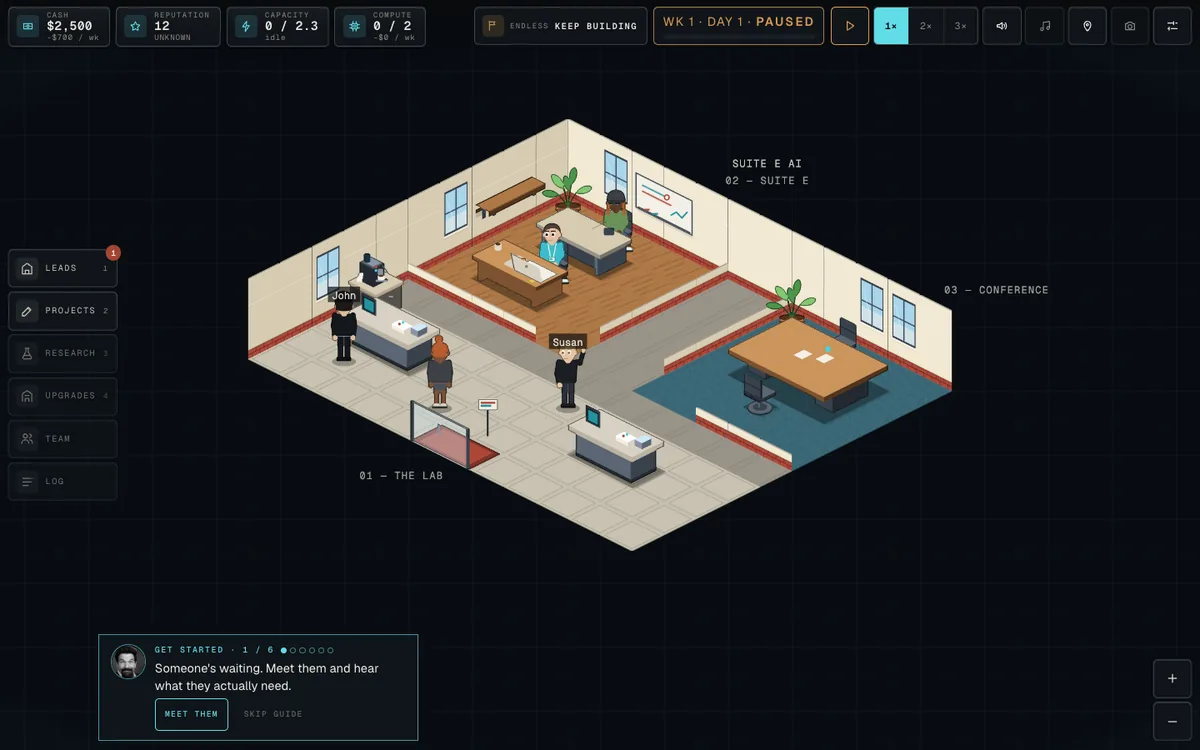
    A small starting office in isometric view with cutaway interior walls, showing the lab and the founder's desk.
    Interior walls became cutaways, so nobody loses their legs behind a partition.
    • Interior partitions became low cutaways; outer walls stand taller than a person
    • Flat materials with one light and one contact shadow, no gradients or blur
    • Monitors and laptops face the person actually using them
    • Per-stage framing that keeps the focus clear of the HUD on small screens
  37. FIX

    The world uses far less graphics memory

    Long sessions were holding well over a gigabyte of graphics memory, and changing the render quality leaked a whole copy of the world. Both are fixed.

    • Chrome graphics use dropped from roughly 1520 MB to roughly 500 MB at standard
    • Switching render quality no longer leaves the previous world resident
    • Verified pixel-identical across scenes, canvas sizes and both themes
  38. NEW

    Public alpha opens, with feedback built in

    The Lab went to public alpha, and a Send feedback panel shipped with it so players can say what they think in plain text without an account.

    • Send feedback from Settings and from the campaign finale
    • Anonymous plain text: no account, no email address
    • Works with analytics turned off
  39. NEW

    Come back after a break and get a recap

    Returning after six hours or more opens on your company's name, what happened last time, what needs a look right now, and what you were working toward.

    • Three highlights drawn from your six most recent moments
    • What needs attention now, written in the game's own words
    • Your next campaign milestone, with a progress bar where there is a number
    • Nothing ticks while the recap is on screen

    Worth knowing
    A reload sooner than that opens the Lab directly, the way a backgrounded tab does. New players get the opening exactly as before.

  40. NEW

    Export and import your save as a file

    Settings now tells you where your save lives and when it last saved, and lets you export it to a file and import it back, which is how you move a company between browsers.

    • SAVED, SAVING or SAVE FAILED status with where and when
    • Export writes a checksummed file; import validates it before touching anything
    • Reset moved into a Danger zone with its own confirmation

    Worth knowing
    The save lives in that browser only, and Settings says so plainly. A failed import leaves you exactly where you were.

Take the empty office.

One desk, one laptop, $2,500, and nobody who has heard of you yet. Everything on this page is what happens after that.

AI STATUSALREADY HERE